Betsy Chernoff. January 27, 2026
TL;DR AI infrastructure is shifting toward AI factories—integrated systems built to produce intelligence (tokens) at enterprise scale.
- AI factories unify data pipelines, training, fine-tuning, and inference into one coordinated platform
- They enable faster deployment, elastic scaling, and continuous improvement via feedback loops
- The result is AI that becomes a shared enterprise capability, not a scarce resource limited to a few teams
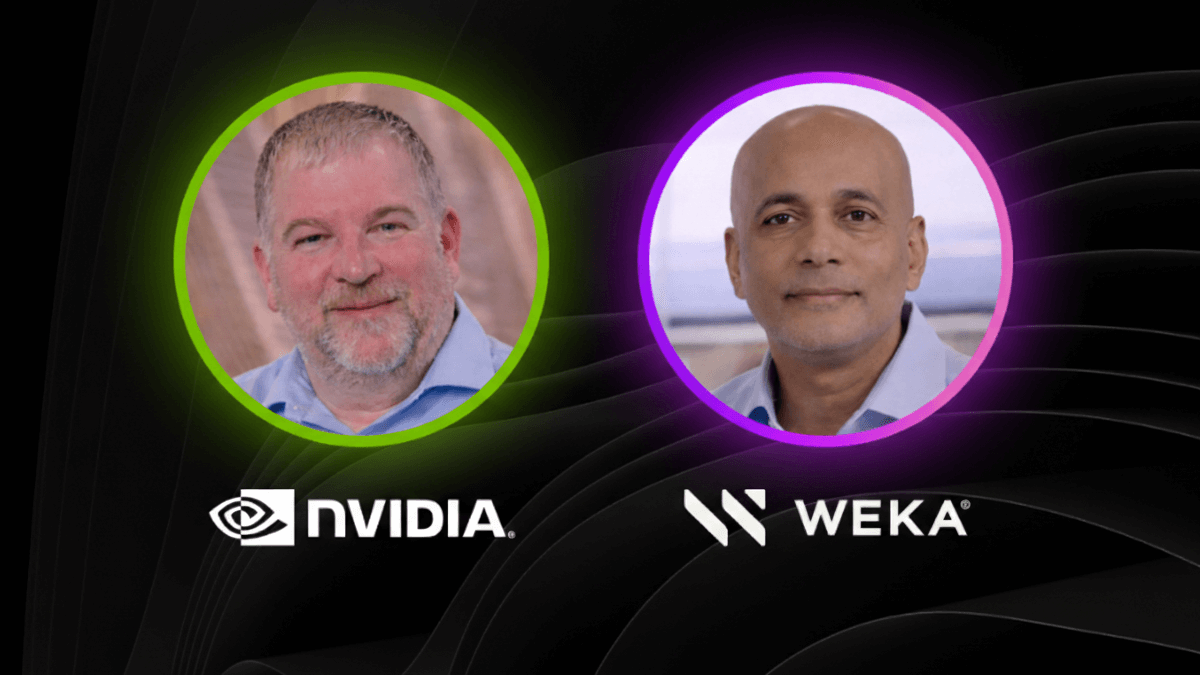
WEKA’s Chief Strategy Office, Nilesh Patel recently interviewed Charlie Boyle, NVIDIA’s VP of DGX Systems, about this transformation happening in AI infrastructure.
The conversations around AI are starting to shift in a meaningful way.
This is something I noticed this past November at SC25. People were no longer talking about what AI can do for individual applications or even how it can augment existing workflows. Instead, the talk was about data pipelines, the limits of compute power, and the need for scalable, affordable, and persistent memory.
In other words, the industry is beginning to grapple with a bigger question: How do we build AI systems that don’t just work for a handful of teams or use cases, but that can support an entire enterprise?
This is the future of AI. It’s how it will move from a feature to a foundation, from something bolted onto existing systems to the backbone for which modern enterprises run. We’re not fully there yet, but the direction is becoming clear. And it requires thinking much bigger than we have before.
The Emerging Importance of the AI Factory
AI factories are a concept Jensen Huang and NVIDIA have been talking about over the past year that has gained traction. They are increasingly seen as key to making AI truly democratic and transformative.
To understand what an AI factory represents, it’s worth starting with how NVIDIA describes it. As Charlie Boyle, VP of DGX Systems at NVIDIA, put it during a sitdown interview with WEKA’s Chief Strategy Office, Nilesh Patel:
“An AI factory is built to create intelligence in the form of tokens. What our customers are looking for is one type of infrastructure that can produce the tokens they need today but also be ready for the future.”
What Boyle is calling out here is how AI development is becoming an industrial process. Rather than trying to use traditional data centers and infrastructure to power AI, or even grafting a dedicated AI data center onto an existing system, an AI factory fully integrates every stage of AI production – from data ingestion and training to fine-tuning and inference. The result is a coordinated, scalable, and efficient system optimized for high-volume AI performance.
Hi, everyone. This is Nilesh Patel, chief strategy officer at WEKA. I’m glad to be here with Charlie Boyle, VP of DGX Systems at NVIDIA. Charlie, welcome, and thanks for joining. Thanks, Nilesh. And we are here today discussing some of the key factors that a lot of enterprises have to consider in designing, building, and scaling their AI infrastructures and take into account some of the challenges of data infrastructure that associated with that. Charlie, give us an introduction to AI factory. Why is it needed? And the importance of high throughput, low latency data infrastructure for those AI factories. You know, so an AI factory is really built to create intelligence and intelligence is in the form of tokens. And, you know, what our customers are looking for is one type of infrastructure that can produce the tokens they need today but also be ready for the future. You know, new models are coming out. New reasoning models. You know, new data models are coming out every day. And so they want a factory infrastructure that they can depend on, they can grow, and know that as the new latest AI technology comes out, that the factory they’ve built today is going to work with the models of tomorrow. So really building that flexible adaptable AI factory is your super core to to our customers today. That’s great. And I guess, AI factories are generating tokens as an output, but the data is the fuel Yep. To those AI factories. What’s your experience in terms importance of scalable, high performance data infrastructure like Weka’s for some of those AI factories and those deployments? Yeah. And you hit it exactly right. You know, data is the fuel for the AI factory. It’s the input, it’s the raw materials. And, that’s what really enterprise customers are looking for today is they’re sitting on, you know, decades worth of enterprise data. They know from everything they’ve heard in the media that they can extract value out of that. But, turning that, you know, enterprise data they have into intelligence, into tokens, you know, really requires, you know, a robust AI infrastructure to do that. But the data infrastructure behind it is so important because your model is only as smart as the data that you put in it. So, you don’t just want to give your model everything in your enterprise because there may be useful things. There’s probably things that aren’t useful. And so, curating the data, having a data platform that can intelligently figure out what a customer needs to put in their model to get the best output, to get the most valuable tokens out of it is super important. That’s a great point and I believe that’s where Weka comes into play with Weka’s neural mesh. We’ve been able to deliver, you know, sub millisecond latencies, tens of terabytes per second throughput, and amazing scale across hundreds of storage nodes and so on. And that’s helping customers achieve their outcome, particularly when they’re, as you pointed out, in the more modern AI infrastructure with agentic workflows, you need rag up the scale that is not previously thought about. Reasoning models, multi model environment are really driving the data patterns that is extremely demanding. And being able to have that deployed on a at scale is where I think Neural Mesh is delivering tremendous value to the customers in terms of getting their AI outcome outcome faster. Thank you so much for your time today. Yep. Thanks, Nilesh, and and thanks for the great partnership. If you’re expanding your AI factories or building new ones, come see how NVIDIA and Weka are building AI factories together and let us share our learning with you.
We are still early in this transition. Significant challenges remain until they become standard (some of which, like data pipelines and storage, WEKA is already addressing in solutions like WEKA’s NeuralMesh and Augmented Memory Grid). But enough organizations are beginning to envision AI infrastructure in these terms that it feels like we’re approaching a tipping point at which AI factories move from vision to necessity.
AI factories have huge potential. But the real transformation happens only after they are in place.
Once an enterprise has a factory capable of producing intelligence at scale, new and exciting possibilities emerge. Models can be rapidly deployed and scaled as needed in order to maintain competitive advantage. Just-in-time training and inference can be maintained across unpredictable loads and usage patterns. Feedback loops provide continuous model improvements even as data and inputs grow.
AI stops being a scarce resource rationed to a few high-profile initiatives and becomes a shared capability that teams can build on continuously.
Just as importantly, AI becomes accessible, which changes how it gets used inside the enterprise. Here’s Charlie Boyle again:
“So much is user experience and user acceptance. When [organizations] deploy something internally and people love it, it explodes inside of the company. So having a scalable infrastructure, having an AI factory that’s built for success is super important in the enterprise because they’re going see that success from AI.”
Hi everyone, this is Nilesh Patel, Chief Strategy Officer at WEKA. I’m glad to be here with Charlie Boyle, VP of DGX Systems at NVIDIA. Charlie, welcome and thanks for joining. Thanks, Nilesh. And we are here today discussing some of the key factors that a lot of enterprises have to consider in designing, building, and scaling their AI infrastructures, and take into account some of the challenges of data infrastructure that are associated with that. In fact, I will give you an example of our common customer that has been building large AI infrastructures where they are hosting modern model developers and large AI factories they are bringing onto their infrastructures. And they have recently published some results with Weka where now they are generating four to five times more, token output with half the time for the time to fuzz token. And this type of value is extremely important, particularly as you get down to reasoning model, large context window and so on. And so we’d love to understand what’s your comment and your experience with the other customers on data requirements and how that scales. An enterprise customer can learn a lot from examples like that of very large scale infrastructure because, to your point, people are looking at reasoning models. The whole point of a reasoning model is you’re asking it a question and it’s not just giving you one answer. It’s coming up with one answer and it’s going back in the model and it’s kind of going through recursively to give you, you know, it’s thinking about it. And, but to think about something as you and I are talking, you know, you’re asking me questions, I’m asking you questions. It’s real time. It’s kind of, it’s natural. But inside of a reasoning model, it’s working at supernatural speeds because we’re not waiting to talk to each other to hear words. It’s constantly processing. So, it’s thinking at a rate that is super fast to give you that answer. But as a user, when you ask something a question, you have a certain expectation that it’s going to come back. Getting an answer back quickly, that first token, that first word that’s out is important, like, Oh, the model understands what I’m doing. Then getting all the context right. For our enterprise customers that are looking at these types of solutions, so much is user experience and user acceptance. And when they deploy something internally and people just love it, it explodes inside of the company. They get one model out, get one thing, you know, people start using it like, oh, this is so cool. And then every department, every business unit wants to do that. So having a scalable infrastructure, having an AI factory that’s built for success is super important in the enterprise because they’re going see that success from AI. Thank you so much for your time today. Yep. Thanks, Nilesh, and thanks for the great partnership. If you’re expanding your AI factories or building new ones, come see how NVIDIA and Weka are building AI factories together, and let us share our learnings with you.
AI shifts from being just a tool to an essential, inseparable part of the enterprise ecosystem that benefits everyone.
Make 2026 the Year You Elevate Your AI Strategy
The conversations I had at SC25 and many more that have taken place afterward confirm for me that the thinking behind how to achieve success with AI is shifting. More organizations are embracing the idea that it isn’t just funding or GPUs that will give them a competitive advantage, but the entirety of their infrastructure design.
This is the future we’re already building with partners like NVIDIA. Interested in becoming a part of it? Check out our partner page to learn more about the work we’re doing.