From Prompts to Agent Swarms: Three Considerations for Enterprise AI
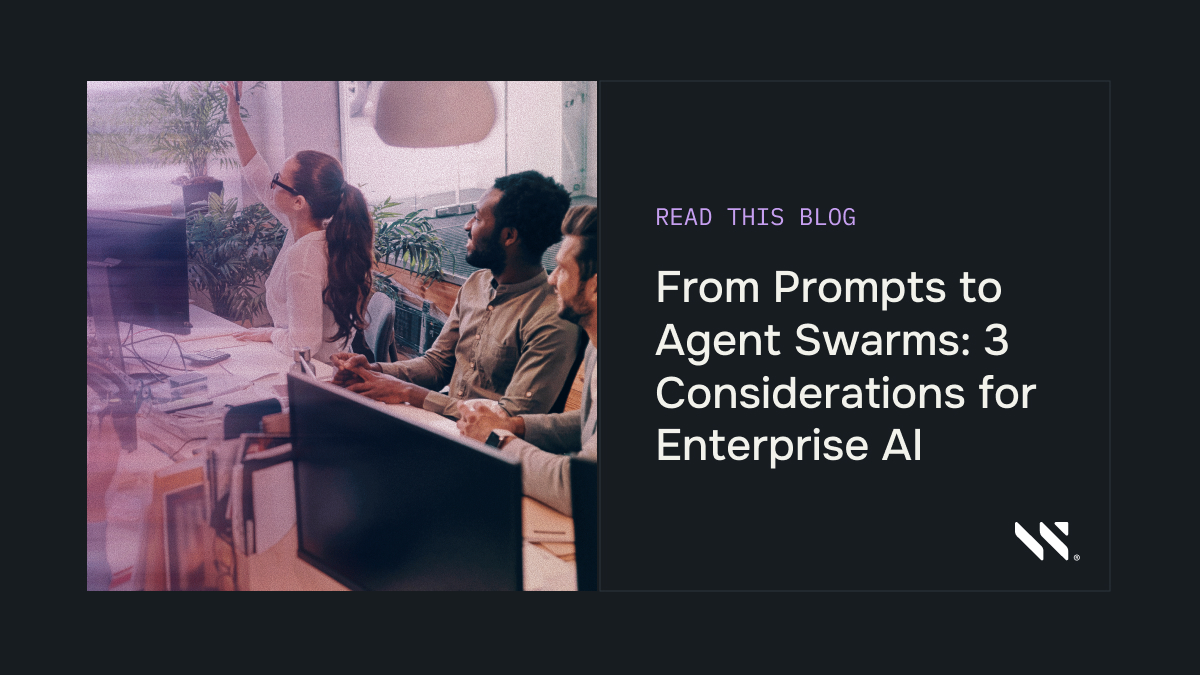

Back in October at the VentureBeat AI Impact Series in New York City, WEKA’s Val Bercovici joined Matt Marshall, CEO and editor-in-chief of VentureBeat, for a fireside chat to discuss the future of enterprise AI.
Spoiler alert: AI is no longer just about entering single prompts into a chat window.
Here are three big bites from their wide-ranging discussion in the Big Apple.
What Are AI Agent Swarms? Understanding Costs and Architectures
A single ChatGPT interaction isn’t an agent; it’s simply a prompt and response. True AI agents are fundamentally different: They distill complex goals into coordinated subtasks, execute them intelligently, and adapt based on results.
Anthropic’s recent Claude 4.5 demo showcased this perfectly. The task? Build an entire Slack app from a single high-level instruction. The result took roughly 30 hours and tens of thousands of dollars, running hundreds of parallel inference sessions simultaneously – but it worked.
Here’s how:
An orchestrator agent—powered by the smartest available model—made high-level architectural decisions about cloud vs. on-premises deployment, performance requirements, privacy considerations, and security architecture. From there, sub-agents executed specific tasks in parallel, each handling discrete components of the application. Throughout the process, evaluator models continuously checked each task’s output against the original specification.
Agentic AI is no longer hypothetical. This Slack experiment is merely a preview of how enterprises will tackle complex workflows across all industries.
Regulation vs. Innovation: Why Timing of New Rules Matters for Enterprise AI Adoption
An attendee from the World Economic Forum raised a critical question: The U.S. is moving fast on AI adoption, while Europe has implemented heavier regulation. Could this regulatory ceiling slow AI’s growth?
The market suggests it already is. OpenAI traffic appears to be tailing off in Europe, with speculation pointing to heavier early regulation that limits access to AI’s latest features, particularly in software development, life sciences applications, and personal productivity tools. When users can’t access cutting-edge capabilities, usage naturally slows down.
Here’s the core tension: The AI industry is still in its infancy as organizations figure out what AI can and should do. Enacting heavy regulations too early risks constraining innovation before we understand the technology’s full potential (as well as its limitations). The U.S. approach has been more innovation-friendly considering AI still has an “off” switch that ensures systems remain controllable.
That said, AI progresses exponentially, not linearly. Better, more thoughtful regulation will be necessary as capabilities expand. The challenge is that today’s regulatory frameworks aren’t well-suited to the technology. Laws that attempt to regulate FLOPs, token counts, or parameter sizes fundamentally miss how AI systems create value and risk.
The right path forward? Enable innovation now, learn what works and what’s dangerous through real-world deployment, and refine the rules based on evidence rather than speculation.
AI Token Economics: The Cost-Value Tradeoff for Enterprises
Enterprise demand for more and more AI tokens is only accelerating. The question is whether the economics of generating them can support real-world business models. The industry is already shifting away from “vibe-coding”—using AI for one-off tasks and experimentation—to building genuine agent-based applications that run in production continuously.
One major rule is emerging: More is more. More tokens can generate exponentially more business value. The challenge is how to do so efficiently to support this growth in an economically sustainable fashion. This is where the AI Triad of accuracy, latency, and cost comes into play.
Accuracy is non-negotiable in enterprise contexts, where a wrong answer is worse than no answer at all. Achieving high accuracy requires lots of high-quality training tokens and inference compute resources. Add necessary guardrails for security, compliance, and responsible AI, and you need even more tokens to maintain this accuracy.
Latency and cost are the variables you could trade against each other (for example, in certain consumer cases where you might tolerate higher latency to cut costs). But in most enterprise scenarios, particularly with the growth of agents, this tradeoff doesn’t work. If a single agent operation takes five seconds and you’re running 1,000 sequential operations, you’re looking at nearly 90 minutes of cumulative latency, which is unacceptable for enterprise production systems.
This means ultra-low latency becomes essential, and achieving this speed is often subsidized. For agent swarms to scale sustainably in production environments, these costs must come down dramatically through more efficient models and smarter orchestration.
The Bottom Line
Agent swarms represent a fundamental shift from single-query AI to orchestrated, multi-agent workflows that can tackle complex, real-world problems.
It’s not just about smarter models; it’s about sustainable token economics, microsecond latency across many thousands of operations, and infrastructure that can support the exponential growth in compute and data movement these systems demand.
For enterprises, the message is clear: Agent-based AI isn’t a future possibility, but rather a present reality that is maturing rapidly. The question isn’t whether to prepare for agent swarms, but whether your infrastructure can support them when they become mission-critical to your operations. And that moment may arrive sooner than we might think.
This event in New York was just one of WEKA’s stops on the VentureBeat AI Impact Series. To learn more, check out these additional resources from our September 2025 appearance in San Francisco:
- AI Inference, Agent Swarms, and Token Economics | Val Bercovici at VentureBeat AI Impact Tour
- Efficient Infrastructure Design is Transforming the Future of AI
And if you’re exploring multi-agent workloads, we would love to connect and show you how AI storage can drive your business goals forward. Contact us to learn more.
Popular Blogs From WEKA
Related Assets
-
The Impact of Storage on the AI Lifecycle
The Impact of Storage on the AI Lifecycle
-
The NAND Flash Shortage Survival Guide

The NAND Flash Shortage Survival Guide
-
Practical Strategies for Navigating the Memory Shortage

Practical Strategies for Navigating the Memory Shortage