Finish Training Faster. Iterate More.
WEKA NeuralMesh speeds data loading, checkpointing, and experiments so you run more tests and ship better models faster.
CHALLENGES
Your GPUs Can Only Train as Fast as Data Moves
Training Runs Take Too Long
When data delivery falls behind training demand, jobs stall, cycles stretch, and teams complete fewer experiments.
Checkpointing Slows Progress
Slow checkpoint writes stall training. Teams checkpoint less often to avoid delays, increasing the work lost when failures occur.
Training Is a Mixed-I/O Workload
Training mixes small files, large reads, checkpoint writes, model loading, and concurrent clients. Storage has to handle it all.
Shorten Training Cycles. Get More From Every GPU.
WEKA® NeuralMesh™ keeps data moving across the training pipeline so teams shorten training cycles, protect progress, and get more from every GPU.
Keep GPUs in the Training Loop
High-throughput, low-latency data access helps prevent accelerators from starving while datasets are read, shuffled, and processed.
Checkpoint More Often. Recover Faster.
Fast parallel writes reduce checkpoint stalls, enabling more frequent protection and limiting how much work is lost after a failure.
Train Models Faster
Feed training runs with data faster so models complete sooner and teams can move through more training cycles in the same time.
Scale Performance With GPU Demand
Maintain throughput and metadata performance as datasets, accelerator counts, and concurrent training jobs grow.
Training Results, Measured With Production AI Teams
0x
Faster training startup
0x
Faster checkpointing
0%
faster model training



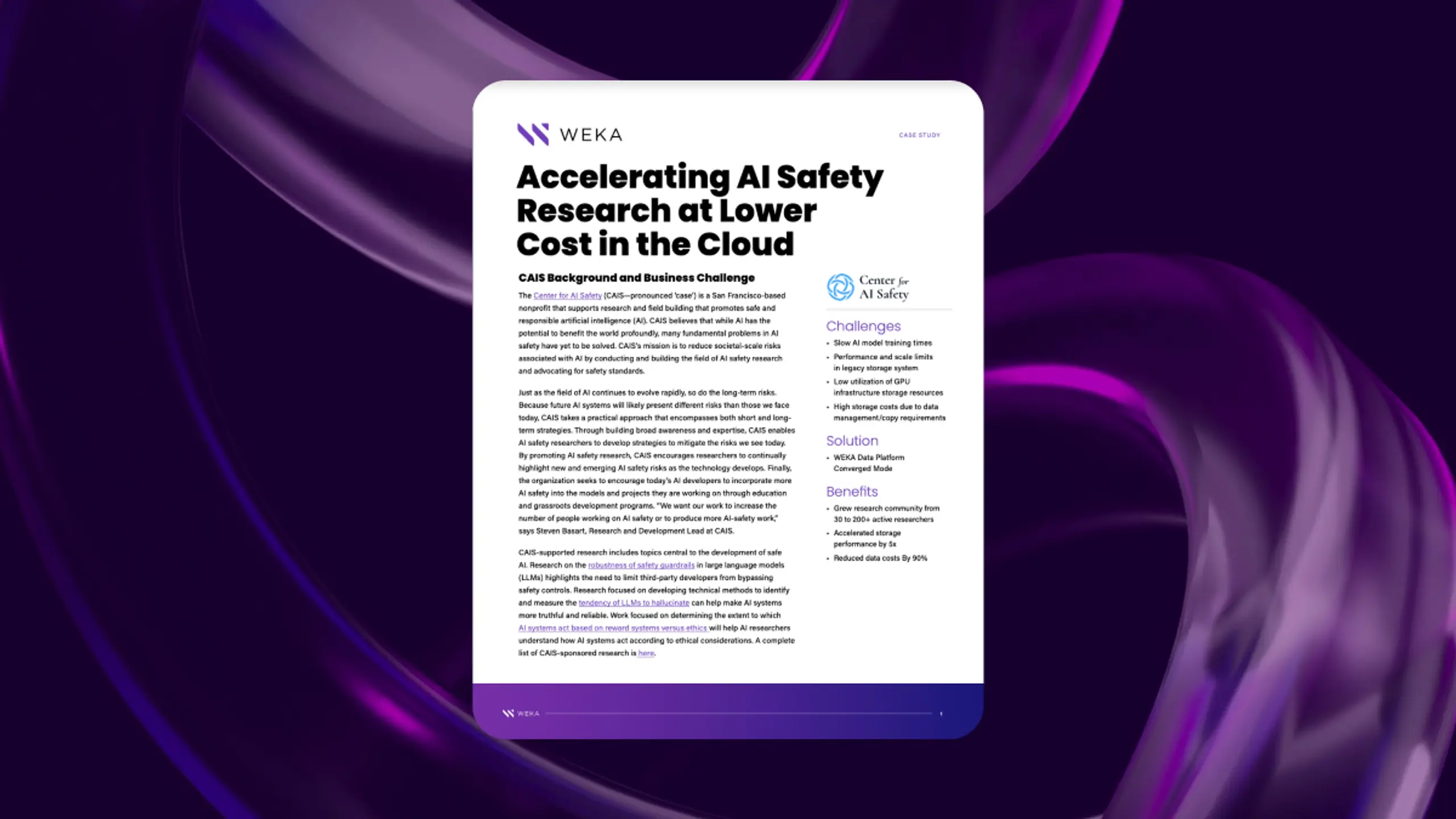
Steven BasartR&D Lead • Center for AI Safety
“WEKA has unlocked a lot of research potential for us. We can support 6 times the amount of research projects and are still growing.”

FEATURES
NeuralMesh is Uniquely Designed with Training in Mind
Features that are designed for the I/O patterns and deployment choices that determine training wall-clock time, resilience, GPU efficiency, and infrastructure cost.
Keep Training Data Moving
NeuralMesh distributes I/O across the system and supports GPUDirect RDMA and Storage, enabling direct storage-to-GPU data movement with less CPU overhead and sustained throughput as clusters scale.

Ready to Train Faster?
See how enterprise AI teams use NeuralMesh to eliminate data starvation and speed up foundation model iterations.
Frequently Asked Questions
Did this page meet your expectations?